


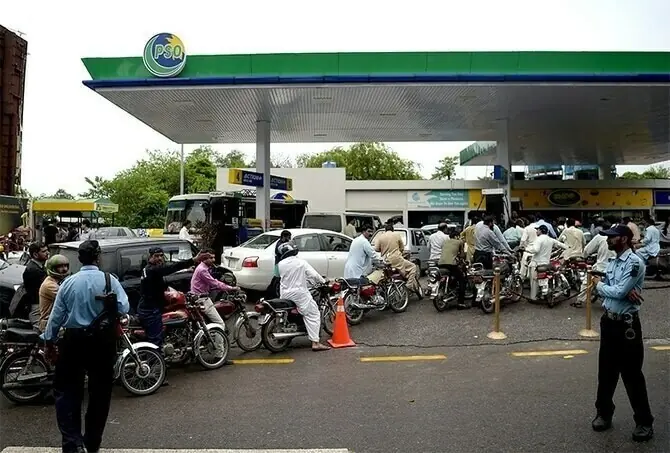
When global crude fell 10% in a week, Islamabad raised the petroleum levy by 13.5%. Petrol prices are up 55.8% in 70 days — not because of oil markets, but by design. What began as a consumer shield has become a federal revenue instrument that bypasses provincial sharing, fuels inflation, and forces the economy into a damaging policy contradiction.
Pakistan’s petroleum levy was conceived as a fiscal shock absorber — reduced when global oil prices rise to cushion consumers, raised when prices fall to stabilise revenues.
In practice, the mechanism works only in one direction. Between May 1 and May 9, Brent crude fell roughly 10%, from $105 to $95 per barrel. Rather than passing any relief to consumers, the government raised the levy on petrol by Rs13.91 per litre — from Rs103.50 to Rs117.41 — pushing the retail price to Rs414.78.
The broader trend is even more revealing. Since March 1, petrol has risen from Rs266.17 per litre, carrying a levy of Rs84.40, to Rs414.78 with a levy of Rs117.41, marking a 55.8% increase in prices — including a 39.1% rise in the levy component alone over just 70 days.
What was designed as a stabilisation tool has quietly evolved into a powerful revenue machine that bypasses provincial sharing, fuels inflation, and imposes costs far beyond the fuel station.
Why has the petroleum levy become the federal government’s instrument of choice? The instrument’s appeal lies in Pakistan’s fiscal architecture. Unlike general sales tax, which under the Seventh NFC Award is shared with provinces, the petroleum levy is classified as non-tax revenue and remains entirely with the federal government. Every rupee collected flows directly to Islamabad, outside the divisible pool.
The economic cost is now visible in inflation. Pakistan’s CPI rose to 10.9% year-on-year in April 2026, returning to double digits for the first time since July 2024 (11.1%), driven largely by energy prices. In the CPI basket, housing, water, electricity, gas and other fuels (23.63% weight) contributed 3.52 percentage points, while transport (5.91% weight) added another 2.06 percentage points. Together, fuel-related categories accounted for over half of April’s inflation. This captures only the direct effect.
Fuel is an input into agriculture, manufacturing, logistics, and food distribution. When fuel prices rise, inflation spreads across the entire economy.
The incidence is also deeply regressive. As a flat per-litre charge, the levy extracts the same Rs117.41 from a daily-wage worker in Lyari as from a corporate executive in Clifton. The nominal burden is equal; the proportional burden is profoundly unequal. Higher fuel prices erode purchasing power, raise production costs, and feed inflation.
Higher policy rates then increase borrowing costs, discourage private investment, suppress credit growth, and slow economic activity. Households pay more to live; businesses pay more to operate.
Perhaps the most troubling contradiction lies in macroeconomic policy itself. By raising the petroleum levy, the government directly injects cost-push inflation into the economy. That same inflation is then used to justify tighter monetary policy. With the policy rate already increased to 11.5%, and markets expecting further tightening if inflation persists, Pakistan finds itself trapped in a self-inflicted policy cycle, with one arm of the state creating inflation through administered fuel taxation. Meanwhile, the other tries to suppress it by raising interest rates.
The latest increases are driven less by oil economics than by fiscal targets. Under Pakistan’s IMF programme, the government was authorised to raise the petroleum levy by a remaining Rs53 per litre in phases; the May 9 revision marks the first installment. Levy collections during July–April FY26 have already reached nearly Rs1.3 trillion against an annual target of Rs1.468 trillion. Perversely, the lower global crude prices fall, the stronger the fiscal incentive to raise the levy further.