


• Before taking off on long-awaited China trip, Trump vows to ‘win peacefully or otherwise’
• Tehran expands Hormuz control as EU mulls post-war naval mission
• Wall Street Journal claims UAE launched strikes on Iranian energy facility last month
• Pakistan pushes China, Azerbaijan on ME peace; earns praise from US president for being ‘absolutely great’ mediator
WASHINGTON: As prospects for peace in the Middle East diminished due to the rigid stances adopted by the US and Iran, the Pentagon on Tuesday said the conflict with Tehran had cost Washington more than $29 billion since the start of hostilities in February, even as consumer inflation in the US hit a three-year high in April.
Jules Hurst, who is performing the duties of comptroller, told US lawmakers on Tuesday that the bill included updated repair and replacement of equipment and operational costs, Reuters reported.
“The joint staff team and the comptroller team are constantly looking at that estimate,” Hurst said. He was speaking alongside Defence Secretary Pete Hegseth and Chairman of the Joint Chiefs of Staff, General Dan Caine.
On April 29, the Pentagon said the war had cost $25bn at that point.
The statement came hours before President Donald Trump took off aboard Air Force One bound for China, the first trip by a US leader to the rival power in nearly a decade. He is set to hold talks on Thursday and Friday with Chinese President Xi Jinping that will focus heavily on trade but also on potential friction points over Taiwan and Iran.
Earlier, the US had rejected an Iranian response bound for China, the first trip by a US leader to the rival power in nearly a decade. Trump is set to hold talks on Thursday and Friday with Chinese President Xi Jinping that will focus heavily on trade but also on potential friction points over Taiwan and Iran.
Earlier, the US had rejected an Iranian response to its peace offer, with President Trump indicating that the ceasefire was on “massive life support”. CNN reported that some aides to President Trump said he was now more seriously considering resuming combat operations in Iran.
Separately, in response to a question about if the US needed China’s help to settle the dispute with Iran, President Trump responded, “No, I don’t think we need any help with Iran. We’ll win it one way or the other. We’ll win it peacefully or otherwise,” Trump told reporters at the White House.
“Their navy’s gone, their air force is gone, every single element of their war machine is gone,” he said, adding that the blockade of Iranian ports has been “1t00 per cent effective”. “One way or another, it’s going to work out very well,” he added.
He also said Iran would not be allowed to build a nuclear weapon. In a separate interaction, he appeared confident that Iran would not build a nuclear weapon. “100pc. They’re going to stop, and they told me, the Iranians told me… they said that we’re going to get the (nuclear) dust,” the US president said in response to a question by a journalist.
He claimed that Iran told him that only the US and China had the expertise to retrieve the nuclear material from the “obliterated” sites.
Last June, Trump said Iran’s nuclear facilities were “obliterated” by US and Israeli strikes during a 12-day war, severely limiting Iran’s capacity to enrich uranium.
His remarks came as Iranian parliamentary spokesman Ebrahim Rezaei said that the country could enrich uranium up to 90pc purity, a level considered weapons-grade, if Iran was attacked again.
“One of Iran’s options in the event of another attack could be 90 per cent enrichment. We will review it in the parliament,” Rezaei, who is a spokesperson for the parliamentary national security and foreign policy commission, posted on X.
Meanwhile, AFP citing Iranian media reported that Iran’s Revolutionary Guards held military exercises in Tehran on Tuesday to prepare for any confrontation.
UAE attacks on Iran
The Wall Street Journal has reported that the United Arab Emirates carried out attacks on Iran early last month.
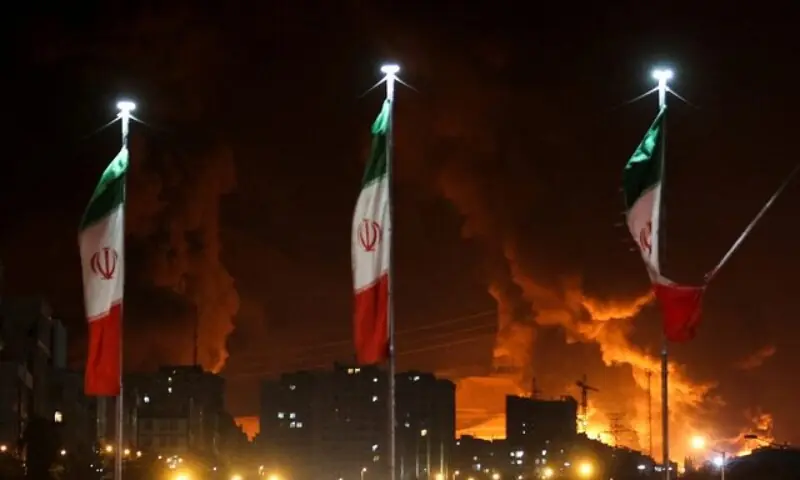
In an article on Monday, the American newspaper said the UAE’s attacks targeted a refinery located on Iran’s Lavan Island and took place “around the time” US President Donald Trump was “announcing a ceasefire in the war” after a five-week air strike campaign.
The US quietly welcomed the Emirati strikes and any other Gulf states that wanted to join the fight, the paper reported, citing one unnamed source.
WSJ did not specify a date or time. However, the morning of April 8, Iranian state broadcaster IRIB said “missile and drone attacks on the Emirates and Kuwait have taken place a few hours after the targeting of Lavan island oil facilities in Iran”, AFP reported.
The refinery was Iran’s 10th biggest refinery as of 2020, handling 60,000 barrels of crude per day, according to EIA figures.
Hormuz deadlock
On the other hand, Iran expanded its definition of the Strait of Hormuz into a “vast operational area” far wider than before the Iran war, according to a senior officer in the Islamic Revolutionary Guard Corps (IRGC) Navy.
The strait is no longer viewed as a narrow stretch around a handful of islands but instead has been greatly enlarged in scope and military significance, said Mohammad Akbarzadeh, deputy political director of the IRGC Navy, the state-affiliated Fars news agency reported on Tuesday.
EU top diplomat Kaja Kallas, however, said the bloc could expand a naval mission it has in the Red Sea to cover the Strait of Hormuz, once the Iran war ended.
“Operation Aspides already makes a crucial contribution in protecting shipping in the Red Sea but its activities could also be extended to the strait,” Kallas said after a meeting of European Union defence ministers. She said that some countries were already promising to contribute more ships to the mission and that could help if the decision was taken to extend its scope.
Diplomatic push
Meanwhile, Pakistan continued its diplomatic push to break the impasse. Foreign Minister Ishaq Dar and his Chinese counterpart Wang Yi discussed regional developments and Islamabad’s ongoing efforts to mediate an end to the Iran conflict. “Both sides underscored the importance of continuing a durable ceasefire and ensuring normal passage through the Strait of Hormuz,” the foreign ministry said in a statement.
Both sides underscored the importance of continuing a durable ceasefire and ensuring normal passage through the Strait of Hormuz, the statement added.
The US-Iran war also came up during a telephone call between Prime Minister Shehbaz Sharif and Azerbaijan President Ilham Aliyev. President Aliyev expressed his deep appreciation for Pakistan’s initiatives to bring about a ceasefire between Iran and the US.
Published in Dawn, May 13th, 2026