


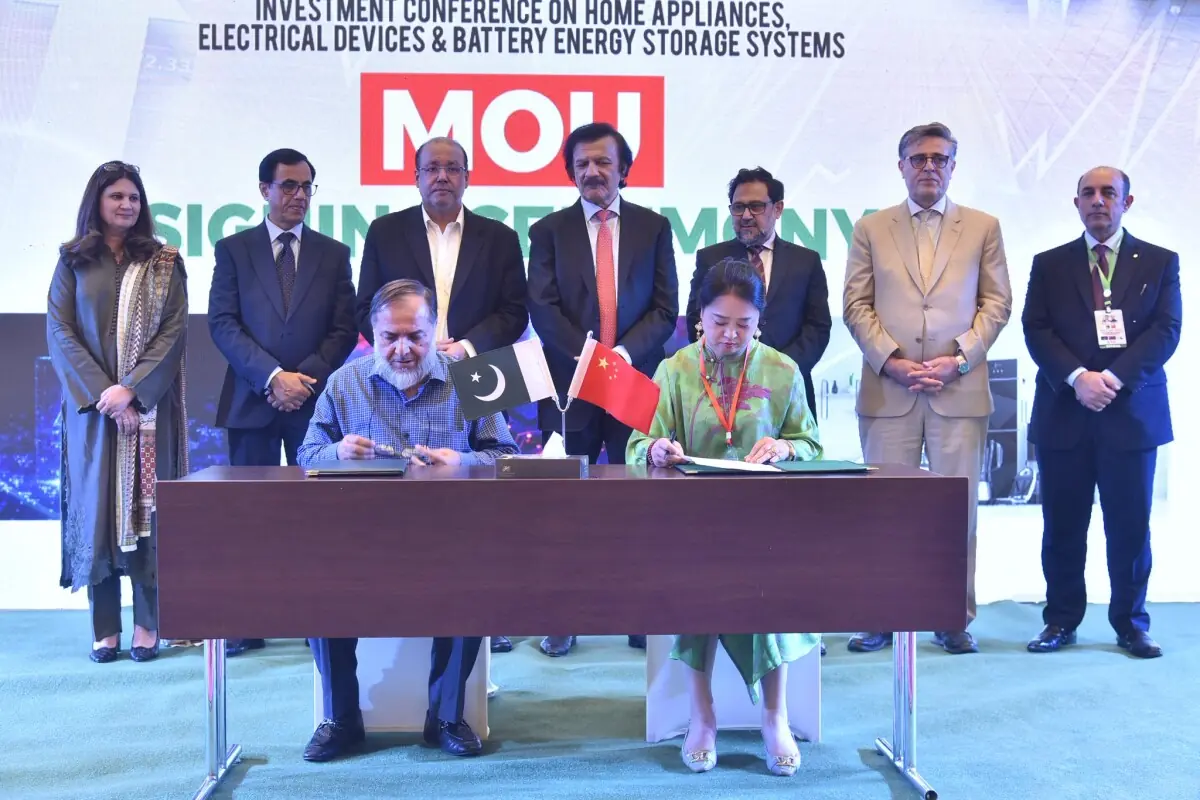
A highly productive matchmaking session was successfully conducted at the Pakistan-China B2B Conference in Lahore, resulting in the signing of dozens of Memoranda of Understanding (MoUs) worth millions of US dollars between leading Pakistani and Chinese enterprises.
As per a statement, the conference brought together 74 Chinese companies represented by 105 delegates, alongside 136 Pakistani companies with 252 representatives from key industrial and commercial sectors across the country.
Substantial progress was achieved across multiple sectors. In the home appliance industry, 15 MoUs were signed, including the highest valued at $40 million. In the electrical sector, 10 MoUs were concluded, with the highest valued at $60 million.
The battery storage sector emerged as a major area of collaboration, with 27 MoUs signed, including the highest valued at $82 million. In addition, over 40 further MoUs and investment proposals are currently under active negotiation.
Earlier, Special Assistant to the Prime Minister (SAPM) on Industries and Production, Haroon Akhtar Khan, said that Pakistan-China relations are based on trust, consistency, and a shared vision, adding that business-to-business engagements between the two countries are opening new economic avenues. He noted that the positive outcomes of the Prime Minister’s visit to China last year are now beginning to materialise, while the confidence of Chinese investors in Pakistan continues to strengthen.
He stated that Pakistan is emerging as a promising destination for investment and that the government is taking practical steps to promote industrial growth, enhance exports, and facilitate businesses. He further said that large-scale reforms are underway to revive industry and boost exports, including the implementation of the National Industrial Policy and National Tariff Policy to reduce the cost of doing business.
The SAPM highlighted that unnecessary regulatory barriers are being removed under the Regulatory Guillotine initiative to transform Pakistan into a minimally regulated and business-friendly economy. He informed participants that special committees have been established to ensure implementation and follow-up of every Memorandum of Understanding (MoU) and Joint Venture (JV), reaffirming the government’s commitment to providing facilitation, confidence, and expansion opportunities to investors.
Haroon Akhtar Khan described Pakistan-China economic cooperation as a major source of development and prosperity for both countries and stressed the need to further expand this partnership. He invited Chinese investors to explore investment opportunities in Pakistan, particularly in manufacturing, technology, and energy sectors, stating that joint ventures in these areas would be mutually beneficial.
He termed the conference an important milestone in strengthening bilateral economic relations, adding that it was not merely a conference but a defining moment for shaping the future of Pakistan-China cooperation. He said the strong participation reflected growing global confidence in Pakistan’s economic direction.
The SAPM further remarked that the next phase of Pakistan-China cooperation would focus on industrial depth and technological integration. Paying tribute to the leadership of Prime Minister Shehbaz Sharif, he said the government had stabilised the economy, restored investor confidence, and strengthened Pakistan’s credibility globally through consistent and effective policies.
Haroon Akhtar emphasised that industrial revival is a cornerstone of the government’s economic policy and that Pakistan aims to become not only a consumer market but also a manufacturing and technology partner. He identified home appliances, electrical devices, and battery storage systems as key sectors of the future, adding that Pakistan’s young workforce and strategic geographical location offer excellent investment opportunities.
He said the world is rapidly moving toward electrification and clean energy, and with Chinese cooperation, Pakistan can become a regional hub for battery manufacturing and energy storage. He added that Pakistan is ready to become an active partner in lithium-ion and sodium-ion battery technologies.
“Pakistan is ready to build, innovate, compete, and lead. Our doors are open, our direction is clear, and our commitment is strong,” he remarked.