


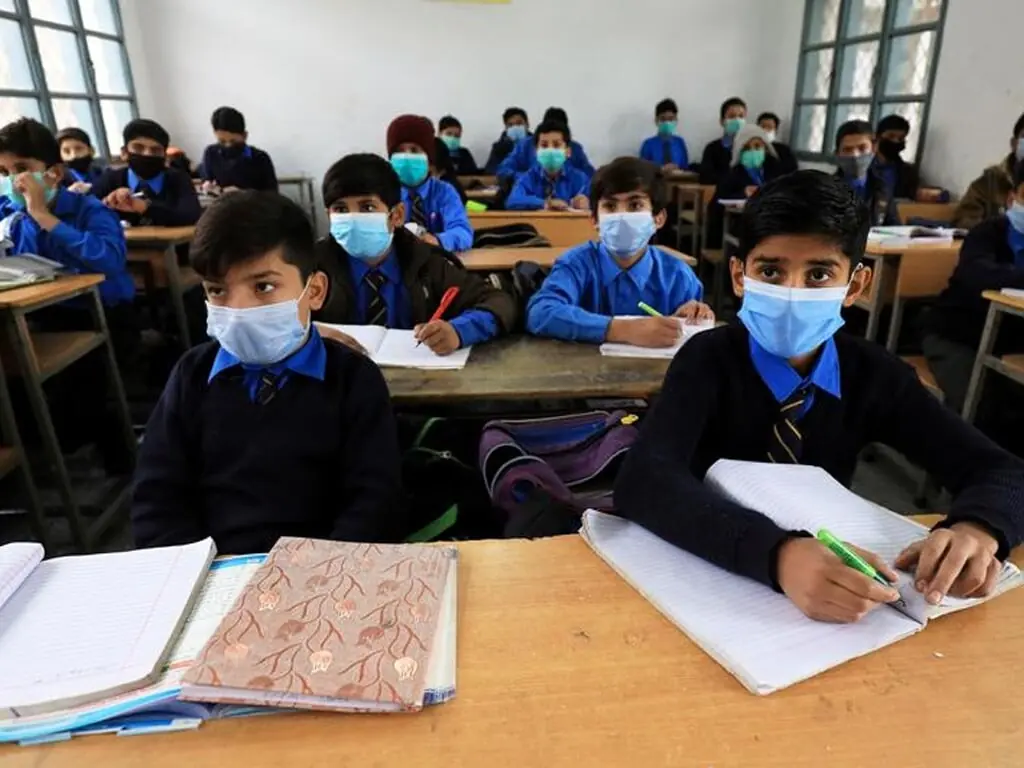
Examination leaks, collapsing public schools, and 26 million out-of-school children are no longer just a social crisis, they are weakening Pakistan’s human capital, shrinking its future workforce, and undermining long-term economic competitiveness.
Pakistan has developed an extraordinarily efficient system for managing its education crisis.
Committees are formed. Investigations are announced. Donor funded reform programmes are launched. Press conferences are held. Reports are published. The one thing consistently missing is actual educational transformation for national objectives.
Examination leaks can no longer be dismissed as isolated administrative failures. They reflect a much deeper governance breakdown.
A student studies for months. An examination paper leaks. The exam is cancelled. Nobody is held accountable.
This has happened repeatedly across Pakistan’s examination boards and assessment systems. Different cities, different students, same outcome. At this stage, examination leaks can no longer be dismissed as isolated administrative failures. They reflect a much deeper governance breakdown.
Also read: Why education’s fast-food model failing in the age of AI
The immediate consequences are obvious. Students are forced to reappear in examinations, results are delayed, university admissions become uncertain, and families absorb additional financial and emotional stress. But the long-term damage is far more serious: the collapse of trust in merit-based systems.
A credible assessment system is not merely an academic requirement. It is economic infrastructure. It tells young people that effort, discipline, and competence can create opportunity. When repeated paper leaks and institutional failures destroy that belief, the consequences extend far beyond classrooms.
Pakistan is already facing a severe human capital crisis. More than 26 million children remain completely out of school, while nearly 80% of the students dependent on public education continue to face weak infrastructure, outdated curriculum, poor learning environments, and limited access to quality teaching. At the same time, Pakistan is attempting to compete in a global economy increasingly driven by technology, automation, artificial intelligence, and knowledge industries.
These realities are fundamentally incompatible.
Countries positioning themselves for future economic growth are investing heavily in education quality, digital literacy, STEM capability, and workforce readiness. Pakistan, meanwhile, continues struggling to secure examination papers and maintain credibility in basic assessment systems.
This has direct economic consequences.
Weak education systems produce weak workforce pipelines. Weak workforce pipelines reduce productivity, innovation, and competitiveness. Over time, economies become trapped in low-value sectors while the middle class the backbone of economic stability erodes.
Historically, education has been the primary bridge through which lower-income households entered the middle class. But when quality education becomes inaccessible and assessment systems lose legitimacy, upward mobility declines sharply.
The wealthy remain protected through private education and international opportunities.
The poor remain excluded.
And the middle class disappears.
Pakistan is increasingly witnessing all three simultaneously.
Governments must appear committed to education without fundamentally altering the conditions that sustain unequal systems. This creates the perfect environment for performative reform: announcements, donor partnerships, pilot projects, technology distributions, and policy frameworks that generate visibility without transforming outcomes.
The international aid ecosystem unintentionally reinforces this cycle.
Development partners require government cooperation to operate. Governments require donor funding and international legitimacy. The result is a system where both sides often prioritise continuity and partnership over difficult accountability conversations.
Education projects continue.
Funding cycles renew.
Reports show “progress”.
Yet examination systems remain compromised, public schools deteriorate, and millions of children remain excluded from learning altogether.
Young people who lose faith in meritocracy often lose faith in institutions more broadly including governance, law, and economic fairness.
The issue is therefore no longer simply about funding. It is about will and accountability.
No education system can improve where institutional failure carries no meaningful consequences. Examination fraud rarely leads to criminal accountability. Administrative reshuffling substitutes for structural reform while public trust continues to decline.
The psychological impact on students is also becoming impossible to ignore.
Repeated examination disruptions create anxiety, uncertainty, and institutional distrust among young people. Over time, students begin to internalise a dangerous message: effort does not reliably determine outcomes. Psychologists describe this as learned helplessness a condition in which repeated exposure to uncontrollable outcomes weakens motivation and long-term belief in systems.
This extends beyond education. Young people who lose faith in meritocracy often lose faith in institutions more broadly including governance, law, and economic fairness. A disconnected citizenry.
Also read: Sindh govt to establish 500 non-formal education centers
For a country with one of the world’s youngest populations, this should be deeply alarming.
Pakistan frequently speaks about its “youth dividend”, but demographic advantage is not automatic. A large youth population becomes an economic asset only when supported by quality education, employable skills, and institutional credibility. Otherwise, it becomes a source of instability, unemployment, and long-term economic strain.
The business community should view this as a national competitiveness issue, not merely a social sector problem or a charity project.
No economy can sustain growth while neglecting the educational foundation of the majority population. Human capital now determines productivity, innovation, investment attractiveness, and economic resilience globally. Countries unable to educate and skill their populations will struggle to compete in higher-value industries.
Pakistan therefore does not simply have an education crisis.
It has a workforce crisis.
A trust crisis.
And increasingly, an economic sustainability crisis.
The country does not need more symbolic commitments or headline driven programmes. It needs measurable learning outcomes, credible examination systems, independent accountability, investment in public education quality, and long-term policy continuity.
Most importantly, it requires acknowledging an uncomfortable truth: education is not welfare spending or political branding.
It is economic infrastructure.
And no country can build a competitive future on a collapsing foundation.
The article does not necessarily reflect the opinion of Business Recorder or its owners.